Florida Travel and Vacational Guide logo - Florida beach resorts , hotels  & attactions

2fla.com Florida Vacation & Travel Guide
Check out area rentals, local restaurants & attraction. Find the Florida locals favorate places. Be a Native on your first Trip.    2FLA.COM Vacation & Travel Guide
Home  Hotels / Resorts Things To Do Florida Facts  Beaches   links Add URL / Update Listing
 

Tampa.gif (3578 bytes)
White Sands
Beach Resort

Florida Facts

Vacation Tips

Florida's Westcoast History

Saltwater Fishing

Hotel/Resort

BeachCam

Florida Attractions

Florida Golfing

Island Resorts

Tropical Breeze
White Sands

Island shopping

Island Restaurants

Sea Turtles

Car Rentals

Games

Help A Seaturtle

Florida Vacation spots

Wedding Information

Island Map

TV CHANNELS

Live Manatee WebCAM
 

Tropical Breeze


Loggerhead, Caretta caretta   ---
The common name is derived from the massive, block-like head and broad, short neck of the animal. It is the only turtle in the genus Caretta and is listed as a threatened species in the United States; international trade is completely banned and the turtle is considered to be vulnerable worldwide.
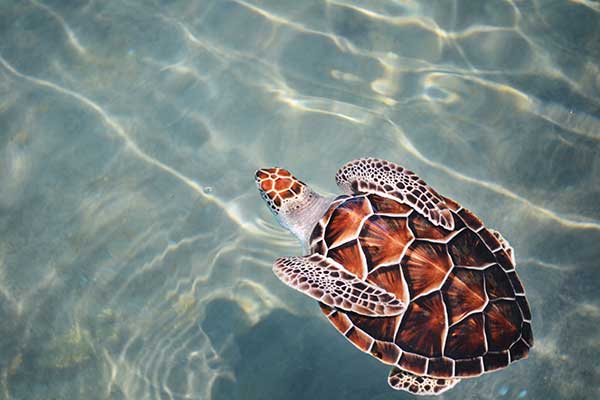
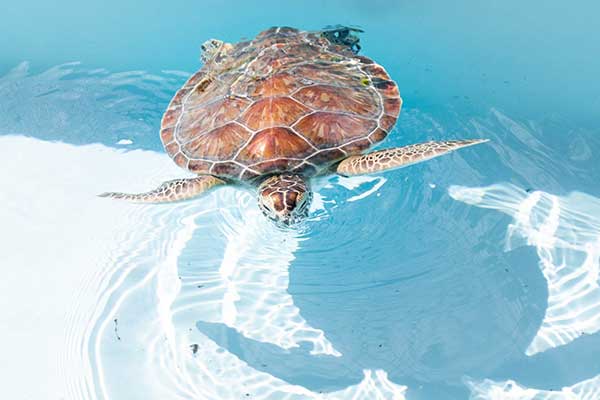
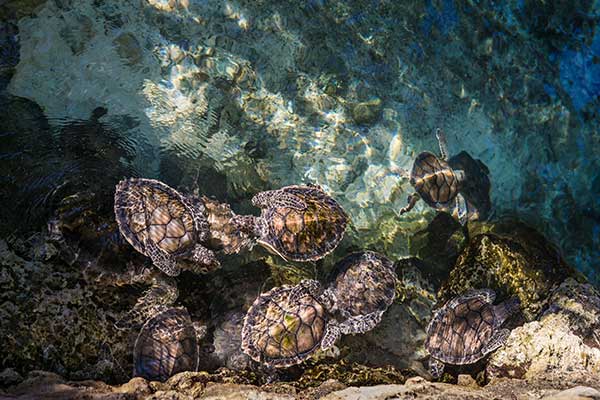
Loggerhead turtles are the most frequently observed turtles in Florida waters. They are one of the largest of the hard-shell turtles, with adults measuring 36 to 38 inches in length, and a weight range of 200 to 350 pounds, but larger specimens have been reported. The upper shell or carapace is widest near the front, just behind the front flippers, then tapers toward the rear. carapace is colored reddish-brown with some yellowish touches; underneath, the plastron is creamy yellow. There are five pairs of costal shields or plates on each side of the central row of plates on the carapace. The shell margin of young loggerheads has a somewhat serrated appearance which disappears as the turtle matures. The limbs are paddle-shaped and each bears two claws. As with all sea turtles, the adult male has a long tail; the tail of the female is short. Biology. Scales on the top and sides of the head and top of the flippers are also reddish-brown, but have yellow borders. The neck, shoulders and limb bases are dull brown on top and medium yellow on the sides and bottom. The plastron is also medium yellow. Adult average size is 92 cm straight carapace length; average weight is 115 kg. Hatchlings are dull brown in color. Average size at hatching is 45 mm long; average weight is 20 g. Maturity is reached at between 16-40 years.Loggerhead Sea Turtles Threatened Species Loggerheads are known to travel as far north as Nova Scotia or south to Argentina. Florida- tagged specimens have been sighted in Chesapeake Bay, in the Bahamas, the Greater Antilles and in the Gulf of Mexico.
As loggerheads mature, they travel and forage through near shore waters until the breeding season, when they return to the nesting beach areas. The majority of mature loggerheads appear to nest on a two or three year cycle.

Like their cousin the tortoise, sea turtles may take their time, but they are remarkably persistent, according to new evidence from an Earth watch sponsored researcher. A satellite tag was recovered in Baja, Mexico, from the flipper of a Loggerhead sea turtle that was tagged in Japan. The tag confirms that endangered loggerheads shuttle nearly 7,500 miles (12,000 kilometers) each way across the Pacific Ocean between nesting beaches in Japan and feeding grounds off the coast of Mexico. Loggerhead turtles are essentially carnivores, feeding primarily on crabs, horseshoe crabs, shrimp, jellyfish, and a variety of mollusks. The strong beak-like jaws are adapted for crushing thick- shelled mollusks.  which they use to eat hard, shelled animals such as crabs and clams. Although loggerhead sea turtles are primarily bottom feeders, they also eat  sea jellies obtained while swimming and resting near the sea surface.

Loggerhead populations in Honduras, Mexico, Colombia, Israel, Turkey, Bahamas, Cuba, Greece, Japan, and Panama have been declining. This decline continues and is primarily attributed to shrimp trawling, coastal development, increased human use of nesting beaches, and pollution. Loggerheads are the most abundant species in U.S. coastal waters, and are often captured incidental to shrimp trawling. Shrimping is thought to have played a significant role in the population declines observed for the loggerhead. 

 Mating takes place in late March-early June, and eggs are laid throughout the summer. 

Distribution
Loggerheads are circum  navigators, inhabiting continental shelves, bays, estuaries, and lagoons in temperate, subtropical, and tropical waters. In the Atlantic, the loggerhead turtle's range extends from Newfoundland to as far south as Argentina. During the summer, nesting occurs in the lower latitudes, but not in the tropics. The primary Atlantic nesting sites are along the east coast of Florida, with additional sites in Georgia, the Carolinas, and the Gulf Coast of Florida. In the eastern Pacific, loggerheads are reported as far north as Alaska, and as far south as Chile. Occasional sightings are also reported from the coast of Washington, but most records are of juveniles off the coast of California. Southern Japan is the only known breeding area in the North Pacific. 

More than 90% of loggerhead nesting activity in the world occurs on Florida’s beaches.
Introduction
Sea turtles are marine reptiles that have existed since their giant land turtle ancestors returned to the sea sometime during the Age of Dinosaurs. Eight species of sea turtles have managed to survive to modern times. Three of these extant species, the loggerhead sea turtle (Caretta caretta), the green sea turtle (Chelonia mydas), and the leatherback sea turtle (Dermochelys coriacea) nest on the beaches of Broward County from April through September every year. The loggerhead is the most common sea turtle using the area for nesting; as a matter of fact, Florida, from the Space Coast to the Gold Coast, is the second most important nesting area in the world for loggerhead sea turtles.
loggerhead turtles were found buried in silt off Palm Beach Inlet and the Indian River, and lodged in the soft muddy walls of the Cape Canaveral Ship Channel. This previously unknown activity may be a type of hibernation, or simply a way to warm themselves, since they are susceptible to hypothermia in cold water. The mud covering may also serve to rid the shell of encrusting barnacles.  . . This reddish-brown turtle is named for its large head which may be 25 centimeters (10 inches) wide. Powerful jaw muscles allow the loggerhead to crush heavy-shelled clams, crustaceans and encrusting animals attached to rocks and reefs. The shell is very thick, particularly toward the back, which may serve as protection from sharks that occasionally prey on this relatively slow swimmer. It is estimated that loggerhead turtles reach maturity between 20 and 30 years of age and have a maximum reproductive lifespan of about 30 years.
Loggerhead, Caretta caretta 
The loggerhead turtle is the most commonly found sea turtle in Florida.
While all other species found near the U.S. coastline are listed as endangered,  It is the only turtle in the genus Caretta and is listed as a threatened species under the federal Endangered Species Act. This means loggerheads are more numerous than the other species, but they are still in danger of extinction.  international trade is completely banned and the turtle is considered to be vulnerable worldwide. Named for its large block-like head, which can be ten inches wide and broad, short neck of the animal., it has powerful jaws to crush the heavy-shelled clams, crabs and encrusting animals on which it feeds They are one of the largest of the hard-shell turtles, with adults measuring 36 to 38 inches in length, and a weight range of 200 to 350 pounds, but larger specimens have been reported. The upper shell or carapace is widest near the front, just behind the front flippers, then tapers toward the rear. It is colored reddish-brown with some yellowish touches; underneath, the plastron is creamy yellow. There are five pairs of costal shields or plates on each side of the central row of plates on the carapace. The shell margin of young loggerheads has a somewhat serrated appearance which disappears as the turtle matures. The limbs are paddle-shaped and each bears two claws. As with all sea turtles, the adult male has a long tail; the tail of the female is short. Adult loggerheads weigh up to 350 pounds and have a reddish-brown carapace (upper shell) and a dull brown to yellow plastron (lower shell). Fully grown, a loggerhead's carapace is typically 32 to 41 inches long (82-105cm). Loggerheads lay eggs at intervals of 2, 3, or more years. Nesting season runs from May through September in the U.S. They lay 4 to 7 nests per season, approximately 14 days apart. The average number of eggs in each clutch ranges from 100 to 126, and the eggs incubate for about 60 days. Loggerhead nesting is concentrated in two main areas of the world -- at Masirah Island, Oman, in the middle east and on the coast of the southeastern United States. The Masirah Island’s annual nesting population is about 30,000 females, while up to 25,000 loggerheads nest in the southeast U.S. each year. The majority of nesting in the southeast U.S. takes place on Florida’s Atlantic coast between the inlet at Cape Canaveral and the Sebastian Inlet, especially within the Archie Carr National Wildlife Refuge.

Loggerhead nesting occurs on sandy beaches above the high tide line. If the nest is flooded by the tide, the eggs will "drown" in salt water. The female crawls ashore at night, digs a shallow pit and then makes a nest cavity where she deposits the eggs. The eggs are white, soft and round, measuring about 1-3/4 inches. A clutch averages about 100 eggs. Once the eggs are deposited, the rear flippers fill and cover the nest with sand and the turtle returns to the sea. The female may nest two or more times a season, about 14 days apart. The age of sexual maturity is not known with certainty. Loggerheads are thought to be mature when the carapace length is greater than 30 inches, which may be 13 to 15 years of age. Some people, however, believe that sexual maturity in nature may be as much as 20 to 30 years of age. In captivity, a well-fed loggerhead may reach maturity at seven years, but growth in the wild is much slower. In the past few years, 49,000 to 68,000 loggerhead nests have been recorded in Florida annually.

  The remains of loggerhead turtles have been found under geological formations tens of thousands of years old in the Caribbean. Today, Atlantic loggerheads are distributed throughout the western Atlantic Ocean and Gulf of Mexico, from Newfoundland to Argentina and occasionally along European Atlantic shores and the Mediterranean Sea.Loggerheads are known to travel as far north as Nova Scotia or south to Argentina. Florida- tagged specimens have been sighted in Chesapeake Bay, in the Bahamas, the Greater Antilles and in the Gulf of Mexico.
The lungs are adapted to permit a rapid exchange of oxygen and to prevent gasses from being trapped during deep dives. The blood of sea turtles can deliver oxygen efficiently to body tissues even at the pressures encountered during diving. During routine activity green and loggerhead turtles dive for about 4 to 5 minutes and surface to breathe for 1 to 3 seconds. A female loggerhead tracked at sea made up to 500 dives every 12 hours.

Range and Population Estimates

The loggerhead turtle nests farther from the tropics than any other marine turtle and is found in temperate and subtropical waters in many parts of the world. Loggerheads forage along the inshore and coastal waters of the Gulf of Mexico, the Florida Keys and north along the eastern seaboard as far as New England. Thousands of young adult loggerhead turtles forage on horseshoe crabs in the river mouths and deeper channels of Chesapeake Bay during the summer months.' During the nesting season adult females remain in shallow areas near their nesting beaches. At other times loggerheads can range hundreds of kilometers out to sea.

The southeastern U.S. is one of the most important nesting areas in the world for this species. An estimated 14,000 female loggerheads nest in the southeastern U.S. annually, and only the population of Masirah Island, Oman, in the Middle East exceeds that of the southeastern U.S. The majority of sea turtles that nest on the mainland of the United States are loggerheads.


Important nesting sites are found on the coastal islands of North and South Carolina and Georgia but most nesting occurs along the mainland coasts in Florida. In Florida, most loggerheads nest from Volusia to Broward counties on the east coast, and some nesting occurs from Monroe to Pinellas counties on the west coast.
Powerful jaws crush mollusks, crabs and encrusting animals attached to reefs and rocks 
An estimated 14,000 females nest in the southeastern U.S. each year 
A large turtle: Adults weight 200 - 350 pounds and measure about 3 feet in length 
Hatchlings: 2 inches long 
Nest in Florida from late April to September 
Survival in Florida threatened by drowning in shrimp trawls and habitat loss 


After nesting in Florida from late April to September, loggerheads disperse to feeding grounds throughout the Bahamas, Cuba, the Dominican Republic, north along the eastern U.S. coast as far as New Jersey during the warmer months, and south through the Florida Keys and the Gulf of Mexico. A loggerhead tagged at Melbourne Beach was recaptured 11 days later on the northwest coast of Cuba. To make this journey the turtle must have traveled at least 70 kilometers (40 miles) a day, often against powerful ocean currents.
Another loggerhead that nested at Melbourne Beach was recaptured less than 10 months later 1,500 kilometers (almost 1,000 miles) away in the Dominican Republic. It is not known why turtles travel so far to nest in Florida when seemingly suitable nesting beaches are available near their feeding grounds.


  Loggerhead / Leatherback /   Green Turtle / Hawksbill / Olive Ridley / Kemp’s Ridley / Sea Turtle HelpSea Turtle Links Page    / Sea Turtles 


Hit Counter


• Home • turtles •Home Up Car & Air I,Taxis , Limousine & Rent a Cars Services  from Tampa to St. Petersburg, Bradenton, Sarasota Anna Maria Island THE HISTORY OF HOLMES BEACHHome Up

Great search engines 
Yahoo / Google / MSN / Merchantcircle  / dogpile / www.hotbot.com /

www.webcrawler.com  www.ask.com 

 Links we mentioned 
www.whitesandsbeachresort.com  / www.Tropicalbreezebeachclub.com / www.Annamariaislandchamber.com / www.floridasgulfislands.com / www.myannamariaisland.com   

http://www.holmesbeachfl.org  http://en.wikipedia.org/

This site Copyright 1997 updated 2009

2fla.com Inc
6504 Gulf Drive
Holmes Beach, Florida 34217
contact Webmaster by Email
suggestions@2fla.com